Research

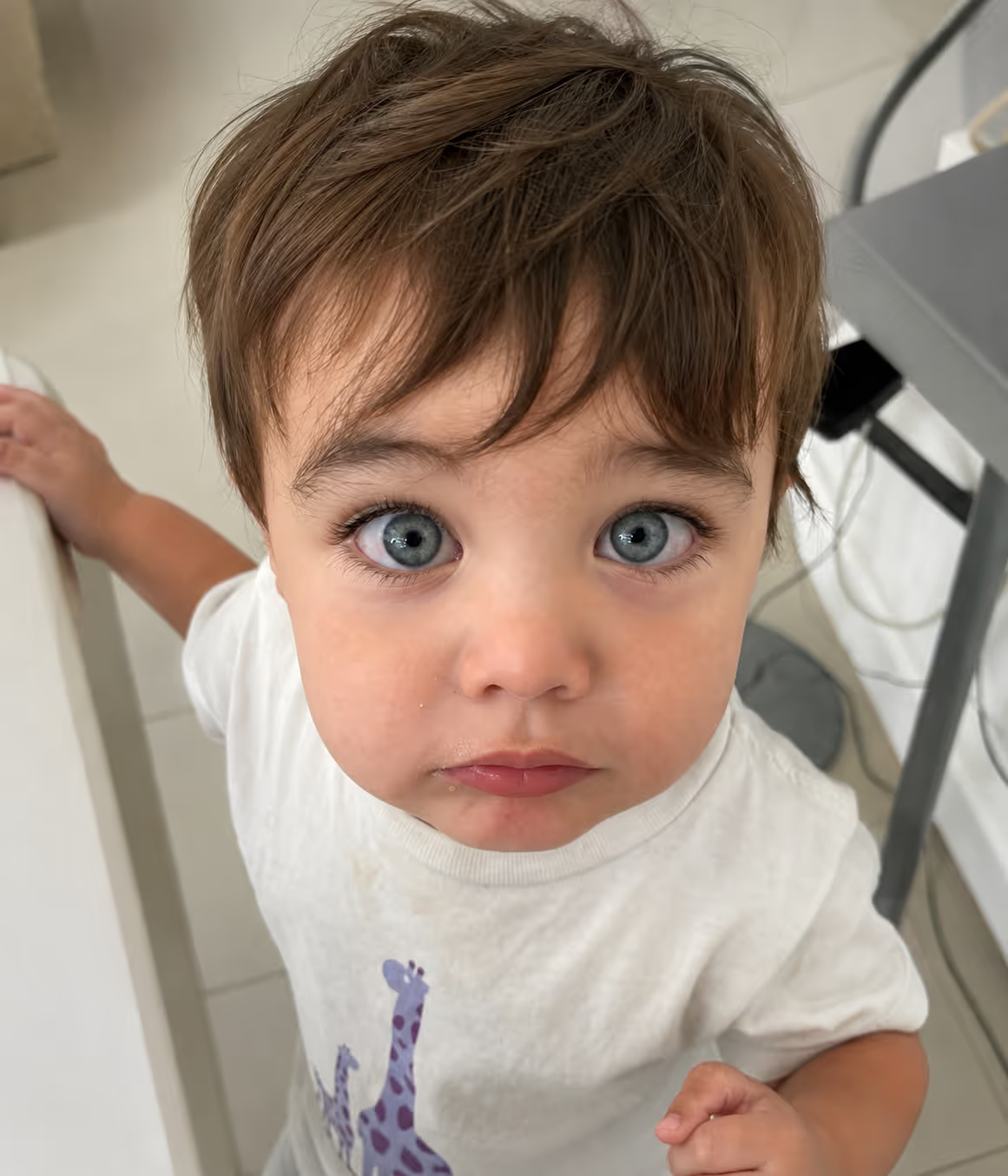
What do babies think? How do they learn language? What do young children know about the world around them?
We blend creative research designs to discover how language and cognition come together in the infant mind, and to trace how this language-cognition link supports subsequent learning and development.
By focusing on dynamic interactions between nature and nurture, we gain insight into the infant and child mind. We align evidence from basic developmental science with the very real challenges facing young children and their families.
Even before babies can roll over in their cribs, language is already a catalyst for learning. Just listening to language supports more than language development alone; it also promotes infants' fundamental cognitive and social capacities as well.

Infants as young as 3 months have already begun to link language and cognition. At first, this link is quite broad. Language, and also a handful of other sounds (including the vocalizations of other primates!) intially support infant cognition. But infants rapidly narrow this link to the languages and communicative signals of their own communities. This is an important first step! Infants use these signals to learn rapidly about the world around them.
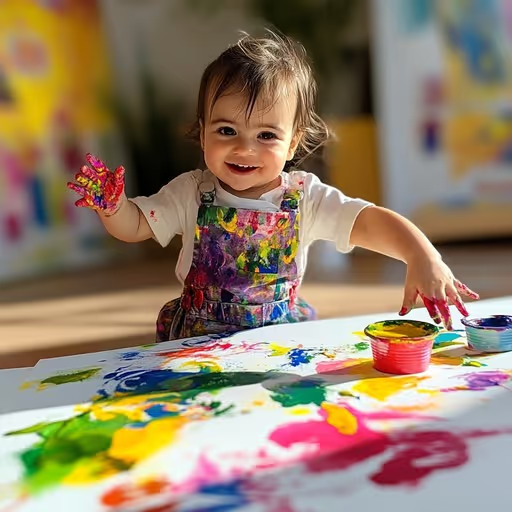
By their first birthdays, infants begin to discover even more precise links between language and cognition. To identify which links might be universal, and how these are shaped by the input, our studies have included infants acquiring languages as diverse as English, French, Italian, Korean, Mandarin, Spanish and Wichi, an indigenous language spoken in Argentina's Chaco rain forest.

Infants’ link between language and cognition has far-reaching effects. It fuels children’s conceptions of the natural world and guides their reasoning about themselves and the people around them.

How do children learn about the natural world and their place within it? What is the relation between humans and other living things? What does it mean to be alive’?
Questions like these require a cross-cultural developmental approach. After all, children living in a village in the Chaco rain forest, and those living in a neighborhood in Chicago, engage with vastly different objects and acquire different languages. Our research engages children living in urban and rural environments, in native and non-native communities in the US and abroad.
Our goal is to support learning environments, formal and informal, that meet children where they are and that deepen their discovery of the natural world around them.

Young children are exquisitely sensitivity to the racial and gender biases they observe in the world around them.
Even as infants, they learn from the words and actions all around them. Our research, in the lab and in the community, is designed to discover how children develop these categories and when they become infused with bias.
Our goal is to use what we learn about children and the people that care for them to create evidence-based interventions to interrupt this bias.
We leverage state-of-the-art developmental science to help children, their families, and their communities thrive. We are delighted to share a rich set of resources — from our own work and others’ — with parents, teachers, schools, community stakeholders, and policy-makers.

It takes a village to raise a child.

My little guy loves exploring! Visiting ICDC is such a great way to contribute to science and give my baby a fun experience at the same time!